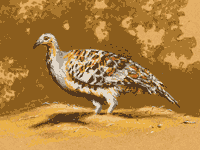
The Mallee Fowl is a mound-building bird of Australia that belongs to a small group of birds called Megapods (big-footed birds). About the size of a chicken, the Mallee Fowl is a very busy worker.
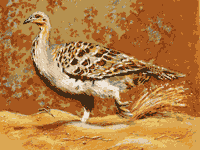 In the fall of the year the father begins to dig a hole about three feet deep. He usually digs the hole by himself using his big feet to scratch out the dirt and sand.
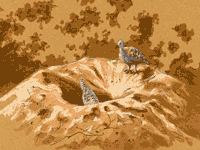 After getting the hole dug, the mother Mallee checks out the hole. When she is happy with the hole he has dug, they both begin to pile leaves and twigs into the pit, until they have a heaping pile of vegetation. After filling the hole with vegetation, the fowls wait for it to rain. After a rain, the father Mallee buries the vegetation with sand, sealing in the moisture.
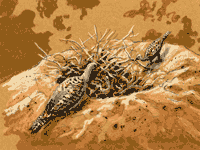 The mound he builds can be up to 35 feet across and up to 15 feet high. He may move up to 3 tons of material (about the same weight as 6 to 8 cars) to build a mound. As the wet vegetation decays, it produces heat. So as the leaves and twigs rot, the pile warms up. What they have built is an incubator for their eggs. Another name for the Mallee Fowl is an Incubator Bird.
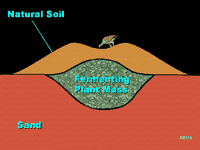 The Mallee Fowl keeps checking the temperature of the vegetation by pushing his heat-sensitive beak and tongue into the mound. It may take up to 4 months for the mound to reach the right temperature (about 92° F). Another name for the Mallee Fowl is the Thermometer Bird. When it is warm enough, the father digs an egg-laying chamber.
 Over a period of many days, the mother lays eggs in the nest chamber. After each egg is laid, the father covers it with sand. He continually tests the nest temperature with his bill, and adjusts the insulating layer of sand to raise or lower the temperature. If the nest is getting too hot because of the rotting plants, he removes sand from the egg chamber to let it cool down. If the sun is making the nest too hot, he adds sand for insulation. If the nest is getting too cold, he will remove sand so that the heat of the sun can warm up the mound. The Mallee Fowl keeps the nest within one degree of 92° F at all times.
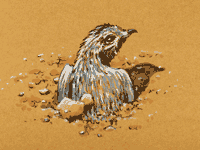
 The mother will visit the nest every few days until she has laid from 6 to 30 eggs. After she lays each egg, she will go off into the bush for a day or so to rest, because laying each egg is hard for her. Her eggs are up to one third her body size. The eggs hatch in about 9 weeks. Each chick has to find its own way to the surface. They may struggle anywhere from 2 to 15 hours, digging themselves out. They get no help from their parents.
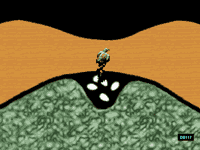 As soon as they heave themselves out of the mound, they totter to shade in the bushes where they rest for a day. Within 1 hour of hatching, the chicks can run and flutter. Within 24 hours of hatching they can fly! The baby birds have no contact with their parents. They are on their own as soon as they hatch.
 The parents rest for 1 to 2 months and then start the whole process all over again. The male Mallee Fowl may spend 10 to11 months just taking care of the nest! That is dedication! When the baby Mallee Fowl mature at 2 years of age, they find mates and start their own nest. How do they know to do that? They were never taught by their parents. No one taught them that as soon as they hatched, they needed to dig their way out of a mound of rotting vegetation and sand. No one taught them which way was up. How do they know to find shelter in the shade as soon as they get out? How do they know to eat seeds and what kind to eat? How do they know that their beak and tongue can be used to measure 92° F, the needed temperature to hatch their eggs? How do they know to add sand or remove it to keep a steady temperature? How do they know that burying wet plants causes them to rot? How do they know that rotting vegetation causes heat? The way they know is called instinct. Instinct is knowledge programmed before birth. Where did this programming come from? Men cannot explain it. Evolution cannot explain it. Such wisdom demands an intelligent beginning. Such intelligence calls for a Creator. “O Lord, how manifold are thy works! In wisdom hast thou made them all: the earth is full of thy riches.” (Psalms 104:24) God made instinct!